
 Active Podiatry - Podiatry in Kent for Runners & Active People
Tight calf muscles. Why it matters and what to do.
Tight calf muscles. Why it matters and what to do.
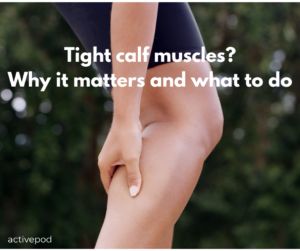
Do your calf muscles always feel tight?
Perhaps you go for a run or a long walk and afterwards you feel as though your calves need stretching.
The obvious answer seems to be: I’ve got tight calf muscles, so I need to stretch them.
But is that true?
The interesting thing is that the current research suggests it’s a bit more complicated than that.
Why are our calf muscles important?
Our two calf muscles, the Gastrocnemius and the Soleus, are an essential component of both propulsion and stability in the lower leg, being responsible for up to 2/3s of the total load in running. They are hard workers, so it is no wonder they get tight.
That sensation of tightness is common after exercise and is a natural response to effort in any muscle. In that context stretching after exercise can help to temporarily increase flexibility and ease any discomfort.
However in some cases that tightness can lead to a restriction in movement, increasing strain on other structures such as the Achilles tendon and plantar fascia, leading to repetitive strain injuries in those structures. Stretching here will help but does not really address the issue of why your calf muscles are constantly feeling tight and uncomfortable.
What causes tightness and what should I do?
The issue here is often tension caused by weakness in the muscle or exercising beyond its load capacity, causing fatigue and tightness. The first can be addressed by strengthening the calf muscle, increasing its functional length and capacity for load, the second by avoiding too much too soon, building up your training in reasonable increments to avoid overstraining the muscles and leading to an unpleasant overuse injury.
Studies show that while stretching can help in the short term, strengthening can lead to important long-term gains in flexibility and load capacity.
In practice a combination of stretching after exercise, building strength with heel raises and sensible progression of your fitness regime with a structured training plan, is the best combination to avoid tight calf muscles which can cascade towards a show stopping injury.
How can I help you?
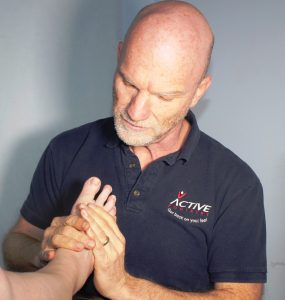
A patient presenting with repetitive calf tightness is a bit of a yellow flag, and I will always test for strength in the calf and surrounding structures, along with reciprocal inhibition in areas such as the ankle joint which may be increasing work in the calf itself. Footwear can also be a key factor with lighter barefoot or minimalist shoes increasing workload in the calf and posterior chain up the back of the leg. A gait analysis can help to identify any movement patterns which may be increasing strain in the calf, and it is important to look at training loads to check for overtraining. With this information I can devise a rehabilitation plan involving strengthening and stability work, gait retraining, footwear modification where needed, and advice on managing training loads.
If you are getting stuck with repetitive calf strains and tightness, give me a call or book an appointment. Always here to help.